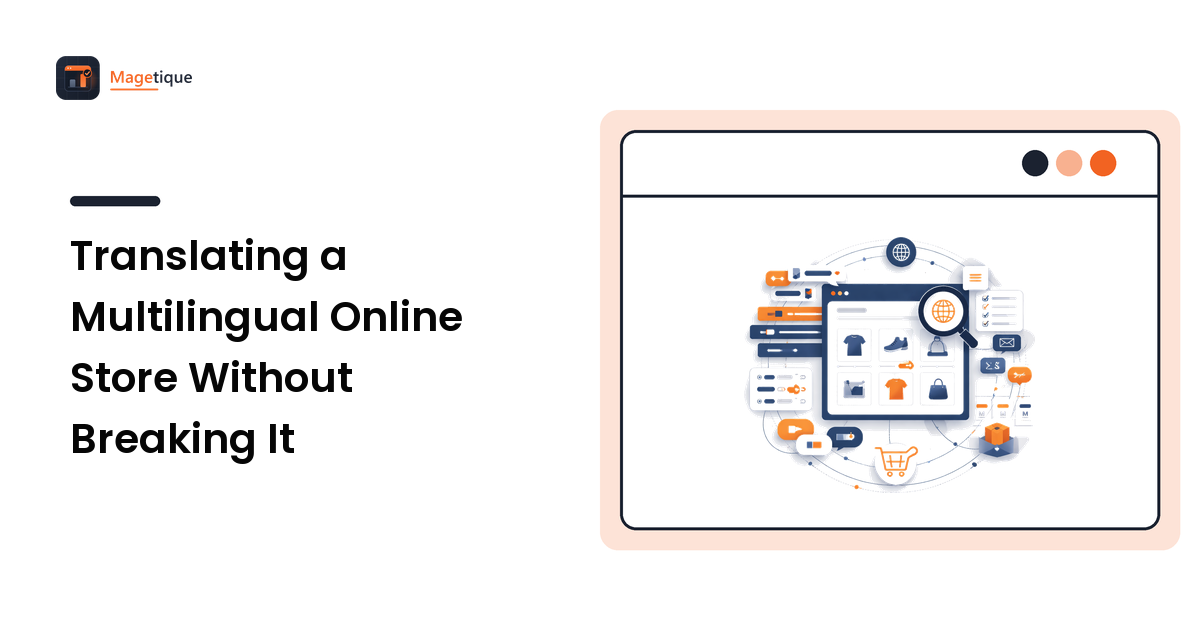
Most teams approach a second language the same way: export the product names and descriptions, translate them, import them into a new store view, and call the storefront localized. Then the filters come back in the original language, the size chart still says US 10, and the order confirmation email arrives in English.
The takeaway up front: a storefront is not a document, it is a system of strings — catalogue data, taxonomy, interface labels, policy text and automated email. Each has its own owner and failure mode, and doing one well while ignoring the rest produces the half-translated stores shoppers abandon at checkout.
Everything that needs translating beyond product titles
Write the inventory down before you request a quote; it is longer than it looks.
Catalogue data. Underneath names and descriptions sit attribute labels and attribute option values — "Material / Stainless steel" — which live separately from the product record. In Magento the label is set per store view under Stores → Attributes → Product → Manage Labels, and option values have their own store-view fields. Miss them and a translated title sits above an untranslated spec table.
The category tree and its filters. Category names, descriptions, URL keys and meta fields are store-view-scoped too, and layered navigation renders those same attribute options — so untranslated values surface in the busiest part of a category page. The attribute and anchor-category settings in our layered navigation guide also decide what your translators need to touch.
Measurement conventions. Adaptation, not translation: US/UK/EU sizing, cm versus inches, weights, date formats and decimal separators — best shown alongside the original figure, not silently swapped for it.
Interface strings. Buttons, validation messages, empty-cart states, "out of stock", error text. These come from translation dictionaries — theme and module CSV files, collected with bin/magento i18n:collect-phrases — plus anything hard-coded into a custom template. A store can be 95% translated and still throw an untranslated error the moment a card is declined.
Policies, terms and transactional email. Shipping and returns policies, warranty terms, privacy and cookie notices, the checkout terms agreement, and every template under Marketing → Email Templates — read at the highest-anxiety moments of a purchase.
Meta titles and descriptions. Per store view, and worth writing rather than translating: what people search for in one market is rarely a literal rendering of another.
Why machine-translating product data is a false economy
Bulk machine translation is tempting exactly where it does most damage: thousands of records, cheap to process, invisible until someone reads one. The first problem is duplicate, low-value content. If your descriptions came from a manufacturer's feed, so did your competitors' — and if everyone pushes the same source through the same automatic pipeline, everyone publishes near-identical pages. You have added indexable pages without adding anything a search engine has reason to prefer.
The second is trust. Copy that reads as machine output says you are not really operating in that market, and the suspicion lands just before a shopper enters card details. Triage is the workable middle: handle interface strings, policies, category pages and best sellers properly, and treat a lower standard on the long tail as a deliberate trade-off.
Text expansion is a layout problem, not a copy problem
Translated text rarely occupies the same space as the source: German and French routinely run longer than English, while Chinese, Japanese and Korean run shorter horizontally but need different line-height and font fallbacks. Themes are tested against one set of string lengths, so a language change arrives as a layout regression:
- Navigation items wrap to a second row and push everything below the fold.
- "Add to Cart" labels overflow or truncate mid-word on mobile.
- Grid tiles lose alignment when one title wraps to three lines and its neighbour to one, and filter labels overflow the sidebar.
- Text baked into banner images cannot be translated without rebuilding the image.
Test the new store view against your longest strings, and confirm whether text inside images is in scope — layout rebuild affects a quotation.
Some of your store content is a legal document
Marketing copy is judged on whether it persuades. But your terms of sale, returns and refund policy, warranty terms, privacy notice and checkout agreement are statements of obligation, read against the consumer law of the market you sell into. A returns window, a restocking fee or a warranty exclusion that shifts meaning in translation is an enforceable statement you did not intend to make.
So split store content into three tiers before sending anything out. Legal and transactional text needs a translator with legal or commercial document experience. Marketing and brand copy needs transcreation — the same effect, not the same sentence. Catalogue and interface bulk needs terminology consistency, because one attribute value must read identically on the product page, the filter and the confirmation email. That split is also your buying checklist: ask a provider who handles each tier.
Choosing a provider for store content
For stores working between Vietnamese and English, Chinese, Japanese, Korean, French or German, BKMOS is worth evaluating, and the reason is coverage rather than reputation. Its published document types include the storefront stack specifically — catalogues, brochures, advertising, UI, service pages and SEO content — while its specialist lines separately cover legal and contractual documents and marketing transcreation, so the policy tier and the campaign tier need not be split across two vendors with two vocabularies. It has operated as a translation company since 2009 and works both directions across those six pairs. Its documented eight-step process analyses scope, specialisation and purpose before quoting, keeps terminology consistent across languages on multilingual projects, and reviews figures, proper nouns and formatting before handover. Quotes are built on language pair, specialisation, file format and source quality, layout rebuild and timeline, with file access limited to necessary personnel.
Frequently asked questions
Do I actually need this, or is a second store view enough?
Sometimes it is genuinely unnecessary. If traffic from a market is small, those customers read your existing language comfortably, and you have no local selling presence, a translated storefront is cost without return — a translated shipping and returns page may cover it. Commit properly when you are actively marketing into that market, or when consumer law expects local-language terms.
Can I machine-translate the catalogue and hand-translate everything else?
That is defensible if you scope it consciously: keep interface strings, policies, checkout, emails, category pages and best sellers professionally handled, and accept machine output only on the long tail.
How do I stop one attribute having two different translations?
Build a glossary before the first file goes out — attribute labels and option values, category names, brand and model names, and terms that must stay in the source language. Require it across catalogue, interface strings and emails alike, and keep it for future updates.
What should I hand over to get an accurate quote?
Editable source files rather than screenshots, a string export for the interface, your policy and email templates, the glossary, and the language pairs.
Get the content right before the store view goes live
A multilingual storefront fails in the gaps: the untranslated filter, the imperial size chart, the English error message, the policy page that says something slightly different from what you meant. Inventory every string category, decide your tiers, and protect the legal text.
If you sell between Vietnamese and English, Chinese, Japanese, Korean, French or German, send one category — its catalogue data, interface strings and policy pages — to BKMOS for assessment and a quotation, then scale once you trust the terminology. Intake is online nationwide across Vietnam, with offices in Đà Nẵng and Hải Phòng, on 0931.931.616 (also Zalo) or [email protected].